
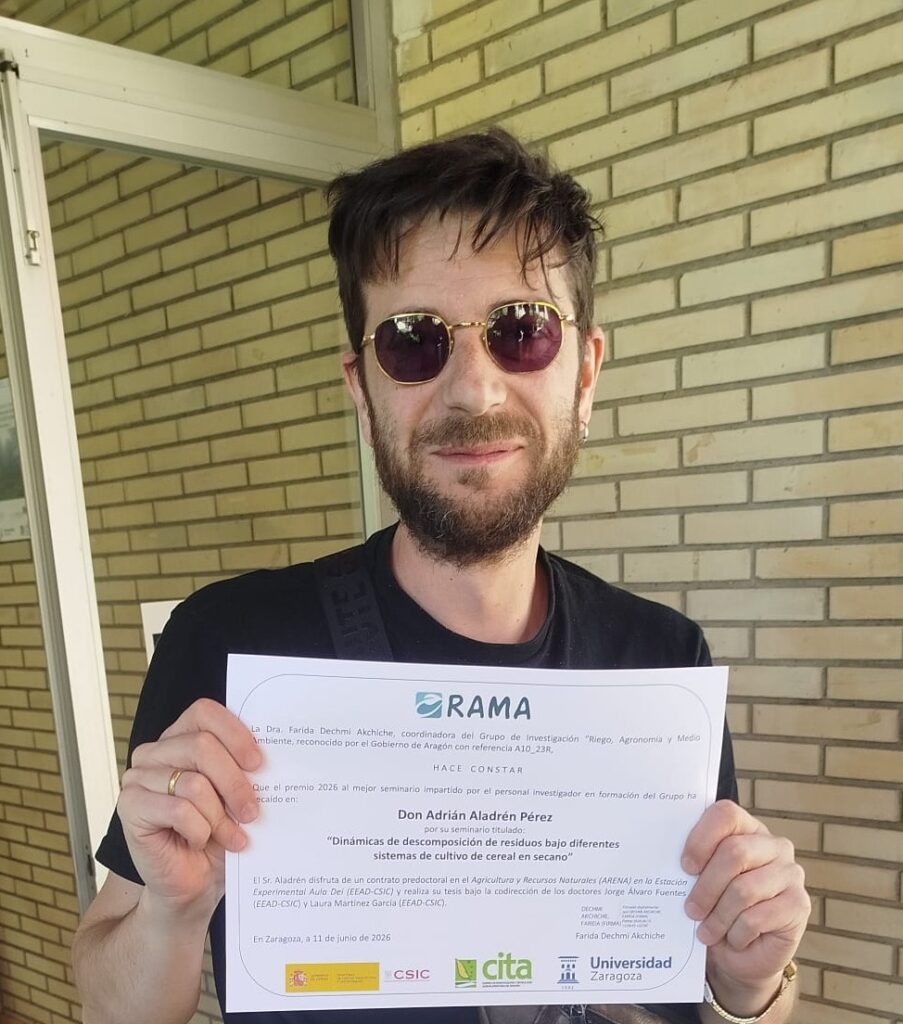
On June 11, 2026, the seminar series of the Irrigation, Agronomy and Environment Research Group (RAMA) officially came to a close. During the event, the 2026 Award for the Best Seminar Presented by an Early-Career Researcher within the RAMA Group was also presented. The award was granted to Adrián Aladrén Pérez for his seminar entitled: “Residue decomposition dynamics under different rainfed cereal cropping systems.”
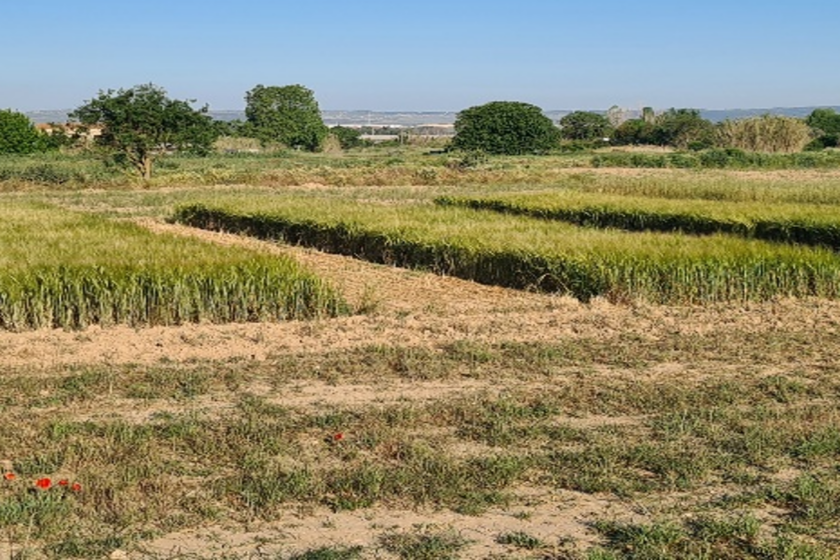
The work presented in Adrián’s seminar highlighted recent advances in research conducted at the Experimental Station of Aula Dei (EEAD-CSIC) on the sustainable intensification of rainfed arable cropping systems in semi-arid environments. The study, carried out within the framework of his doctoral thesis, “Intensification of Semi-Arid Rainfed Arable Cropping Systems: Sustainable Alternatives to the Traditional Tilled Fallow System,” examines how different management practices affect soil carbon and nitrogen cycles. The research is set against the backdrop of global warming, which poses a particular threat to Mediterranean regions, where climate models predict greater temperature increases, more pronounced reductions in precipitation, and progressive soil degradation. In this context, traditional rainfed agricultural systems—such as the long-term tilled fallow practice known as “Año y vez” (alternate-year cropping and fallow)—show significant limitations in terms of sustainability, efficiency, and the conservation of soil organic carbon.
The research is being conducted in two field experiments established on a rainfed farm at the Experimental Station of Aula Dei (EEAD-CSIC). The first experiment compares three barley-based (Hordeum vulgare L.) cropping systems: barley–conventional tilled fallow, barley–chemical fallow with spontaneous vegetation cover, and barley–sown fallow with common vetch (Vicia sativa). The second experiment evaluates different cover crops in barley-based systems (oats, vetch, and an oat–vetch mixture) and two termination methods (mulching and tillage). The main objective of both experiments is to understand how these practices influence soil greenhouse gas (GHG) emissions, organic matter decomposition, physical stabilization of carbon within soil aggregates, and carbon dynamics in deeper soil layers.
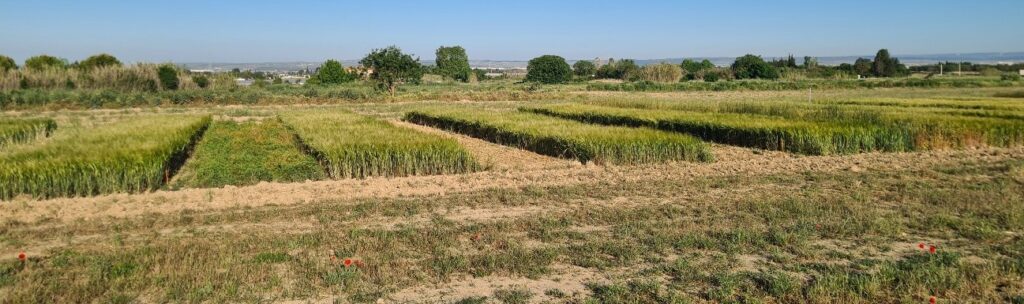
Preliminary results showed that the rapid increase in soil moisture associated with rainfall events during the summer fallow period is a key driver of CO₂ and N₂O emissions. During this year’s presentation in the RAMA seminar series, Adrián presented results related to soil organic matter decomposition. Systems with reduced tillage and the presence of vegetation cover exhibited higher levels of enzymatic activity. The findings also highlighted that most plant residue decomposition occurs during the first weeks after incorporation into the soil, particularly in the case of legume residues, which were associated with greater microbial and enzymatic activity.
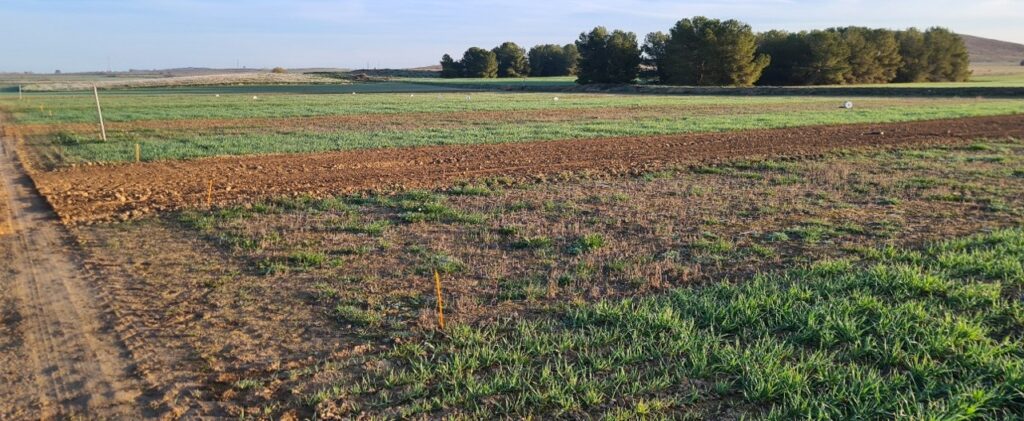
The doctoral research also examines the role of soil aggregates as a key mechanism for carbon stabilization, as well as the importance of studying carbon dynamics at greater soil depths, where carbon residence times are generally longer. This work forms part of the doctoral thesis being carried out at the Experimental Station of Aula Dei (EEAD) of the Spanish National Research Council (CSIC), funded through a predoctoral contract from the Spanish State Research Agency (PRE2022-102686), and linked to the SintMed Project (PID2021-1263430B-C31).