
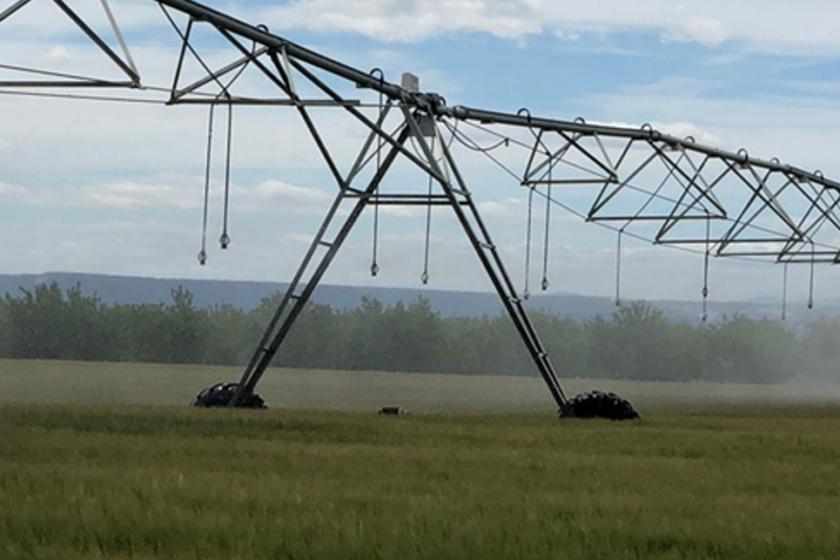
On May 21, a new seminar of the RAMA Group was held, focusing on the application of the Water–Energy–Food (WEF Nexus) approach in centrally managed irrigation systems. The presentation, delivered by PhD candidate Marcos Bongiovanni, used the Monte Saso irrigated area in Biota, belonging to Irrigation District No. V of the Bardenas Irrigation Scheme, as a case study.
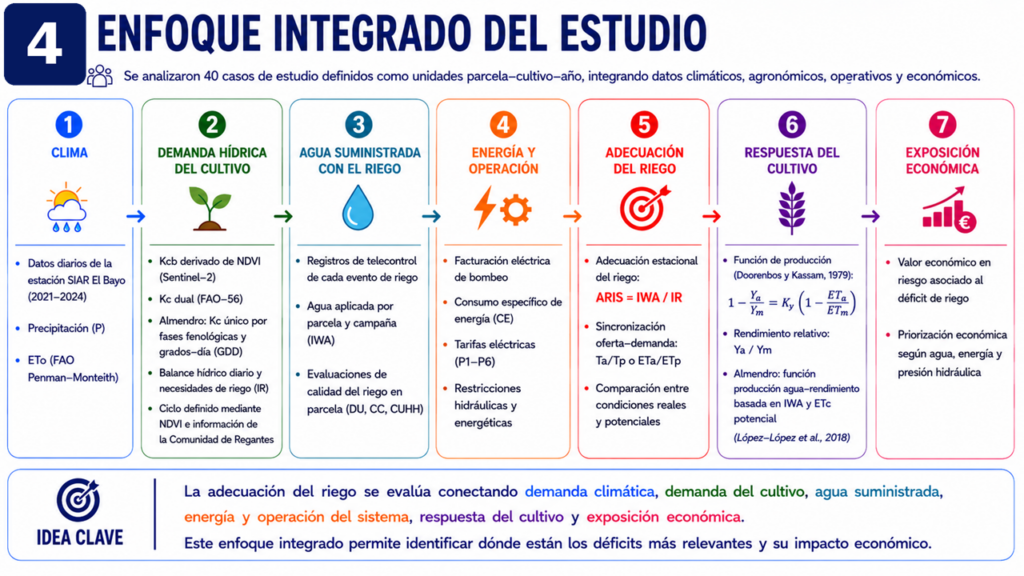
During the seminar, FAO-56 water balance models, Sentinel-2 imagery, remote-control system records, and energy and economic data were integrated to assess irrigation adequacy from a combined water, energy, and agricultural production perspective. The results revealed differences among crops in the system’s ability to meet water demand throughout the growing season and showed that irrigation adequacy depends not only on the total volume of water applied but also on the synchronization between water delivery and the crop growth stages that are most sensitive physiologically. The presentation also examined how demand simultaneity, irrigation scheduling, hydraulic constraints, and electricity tariff structures influence system operation and ultimately shape a compromise solution among operational, energy, and production constraints. Finally, the potential impact of these mismatches on relative crop yield and on the potential economic return associated with partially closing irrigation deficits was discussed.
This work forms part of the doctoral thesis of Marcos Bongiovanni, researcher at EEA INTA Hilario Ascasubi and PhD candidate at the University of Zaragoza (UNIZAR) within EEAD-CSIC, under the supervision of Enrique Playán and Nery Zapata. The doctoral research stay in Zaragoza is funded by INTA and the project “BIRF: Climate-Smart and Inclusive Agrifood Systems” (P176905-BIRF). The research is also conducted within the framework of project PID2021-124095OB-I00, funded by MCIU/AEI and co-funded by FEDER.