
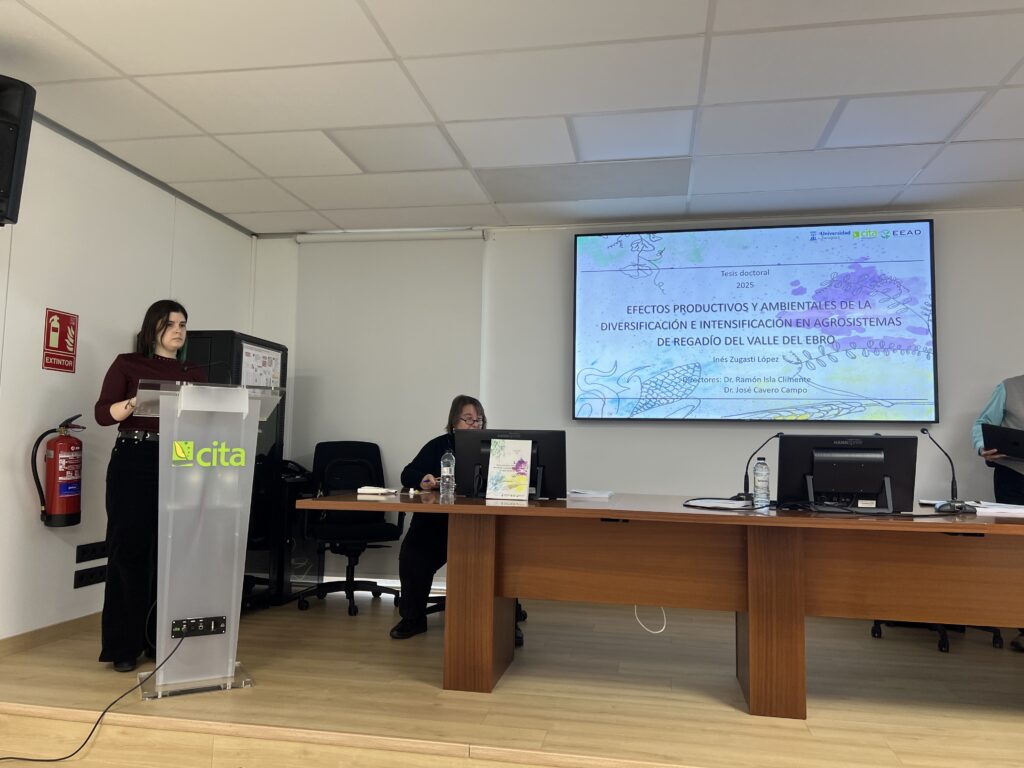
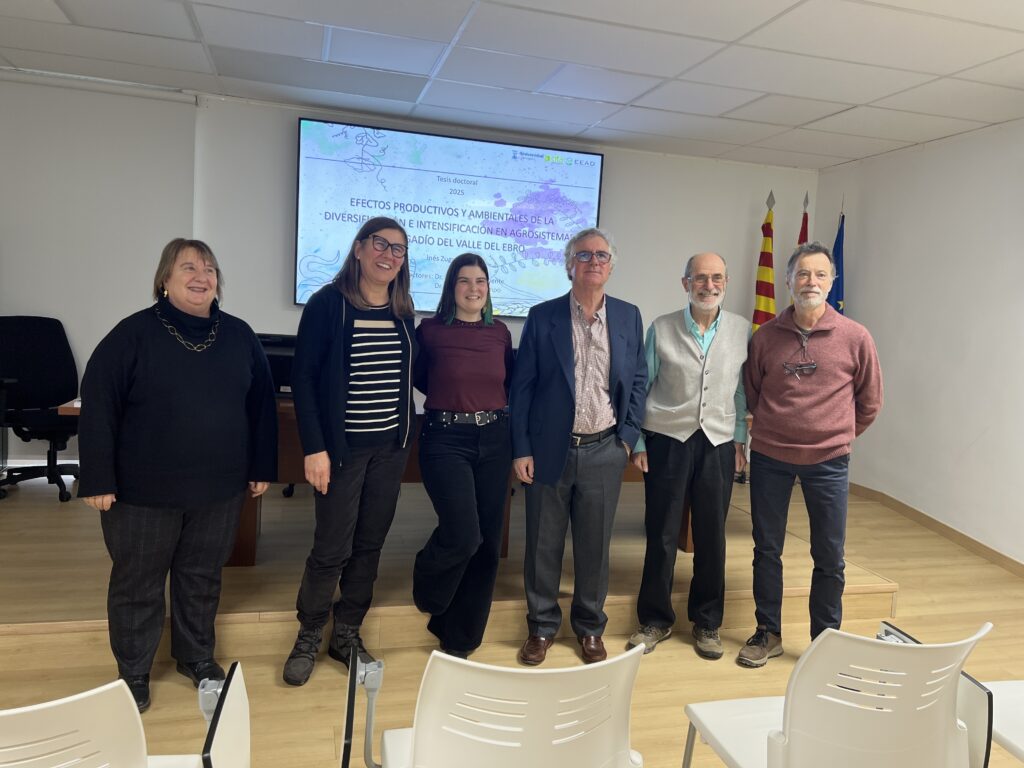
On January 27, Inés Zugasti López obtained her doctoral degree from the University of Zaragoza after defending her PhD dissertation entitled “Productive and environmental effects of diversification and intensification in irrigated agroecosystems of the Ebro valley.” The doctoral thesis, supervised by Dr. Ramón Isla Climente and Dr. José Cavero Campo, received the highest grade, cum laude.
The research examined alternatives to the traditional winter fallow system in maize cropping systems. The options evaluated included the use of legume-based cover crops and double-cropping systems with barley or pea, followed by short-cycle maize.
To assess these alternative systems, three field trials were established between 2018 and 2022, focusing on crop diversification, nitrate leaching, and cover-crop management. These experiments made it possible to analyze grain and protein production, water and nitrogen use efficiency, greenhouse gas emissions, and nitrate losses through leaching.
The results showed that introducing a legume cover crop did not affect total system production and allowed nitrogen-use efficiency to increase by around 20% by reducing fertilizer requirements. Double-cropping systems, meanwhile, significantly increased production. Grain yield rose by up to 39% with barley and 16% with pea, while protein production increased by more than 60% in both cases. Although these alternatives required greater irrigation, they also improved water-use efficiency, especially in the barley–maize system.
From an environmental standpoint, performance differed depending on the strategy applied. The barley–maize system achieved a very substantial reduction in nitrate leaching but showed an increase in greenhouse gas emissions. In contrast, the pea–maize system displayed values similar to the traditional system in both emissions and nitrogen losses.
Overall, the research concludes that diversification and intensification of irrigated maize cropping in the Ebro Valley can be an effective tool for increasing production and improving the efficiency of key resource use. Nevertheless, the study stresses the importance of continued research and evaluation of agronomic practices in order to minimize potential environmental impacts and move toward more sustainable agricultural systems.