

On 6 February, the presentation of the Operational Group “Almaverde: Sustainable Nitrogen Management in Almudévar – Innovative Strategies to Reduce Nitrate Pollution” took place in Almudévar. The project is funded by the Government of Aragón through the AEI Operational Group call under the CAP Strategic Plan (PEPAC) 2023–2027. The project involves the Almudévar Irrigation Community, the Virgen de la Corona District Agricultural Cooperative, Riegos del Alto Aragón, the University of Zaragoza (Unizar) and the Agri-Food Research and Technology Centre of Aragón (CITA).
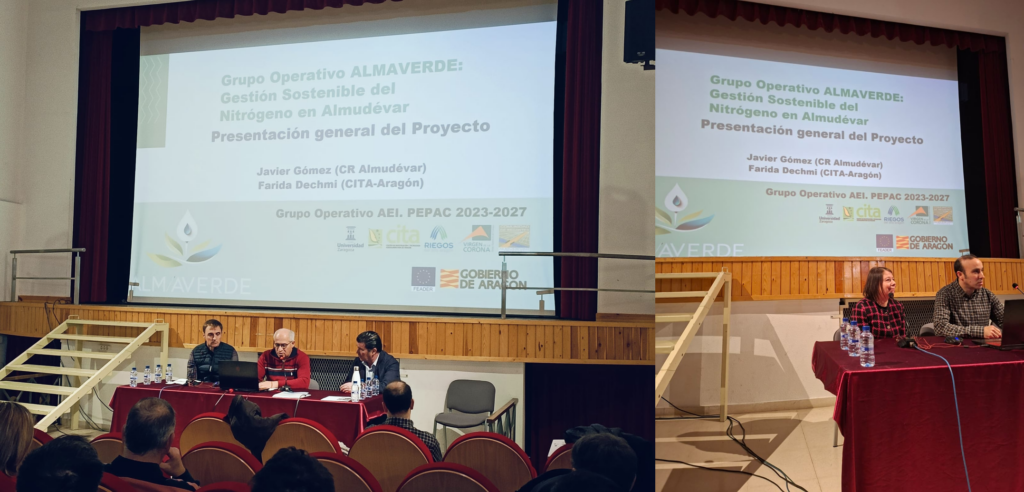
The event was opened by José Antonio Pradas Arnal, President of Riegos del Alto Aragón; Ismael Ballesteros Gimeno, President of the Almudévar Irrigation Community; and Víctor Recaj, representing the Virgen de la Corona District Agricultural Cooperative. During the session, the objectives and tasks to be undertaken over the two agricultural seasons covered by the project (2025–2026 and 2026–2027) were presented. First, Javier Gómez (Almudévar Irrigation Community) together with Farida Dechmi (CITA) explained the need to carry out this project and outlined its general objectives. Subsequently, Farida Dechmi provided attendees with an overview of the current state of knowledge in the La Violada basin, the project’s study area, which has been monitored by CITA over the past decades.
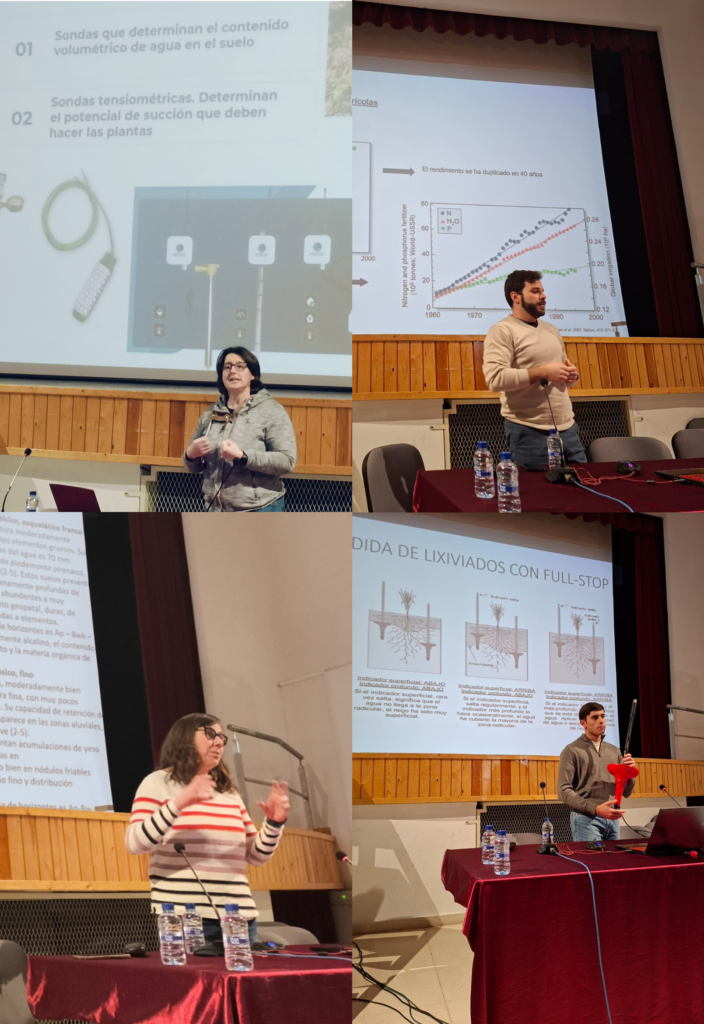
Following this introduction, the different project activities were presented. Raquel Salvador (CITA) explained how irrigation will be managed in order to adjust water application to crop demand, thus avoiding excess water that could lead to nitrogen leaching through deep percolation. Samuel Franco (CITA) then presented the nitrogen fertilisation strategy, also focused on matching fertiliser application to crop needs, thereby preventing nutrient surpluses that could be lost through leaching and cause associated environmental problems. This session concluded with contributions from Asunción Usón and Manuel Samperiz (Unizar). Asunción Usón described the different soils in the La Violada basin, justifying the selection of “shallow” and “deep” soils based on their properties and representativeness within the study area. Manuel Samperiz presented the FullStopTM system, which will be used in one of the pilot plots to monitor potential nitrogen losses through leaching.
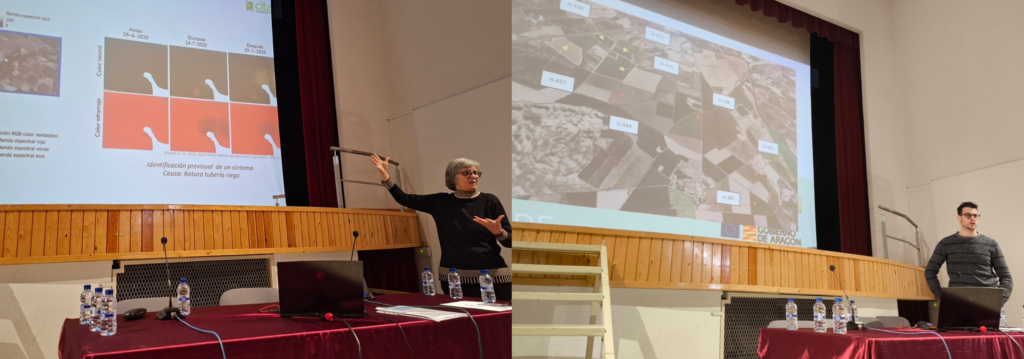
In the final part of the event, Auxi Casterad (CITA) presented the remote sensing work planned within the project, and Raquel Salvador (CITA) detailed the monitoring to be carried out in the different pilot plots using soil moisture sensors. Both strategies aim to improve resource use efficiency and to generate data that will allow verification of the impact of the practices implemented. Finally, Guillermo Catalán (Virgen de la Corona Cooperative) introduced the eight pilot plots where both irrigation and fertilisation strategies will be applied in order to reduce nitrogen losses and, consequently, nitrate pollution.
The main objective of the Almaverde project is to reduce nitrogen losses and, therefore, nitrate pollution in the Almudévar irrigated area through more precise irrigation and fertilisation management. The project aims to demonstrate that crop productivity can be maintained by adjusting water and nitrogen doses to actual crop requirements, while at the same time improving resource use efficiency. Ultimately, the